Wednesday, March 26, 2014

Inspection Of Embedded/Glassed In Chainplates Part 2


I wanted to post more photos from the inspection of the two Irwins I inspected in October 2013.


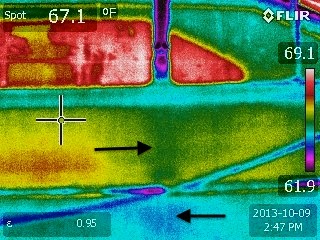
The first step was to take Infrared Images of the area the chainplate is embedded in. Images were taken from the exterior and interior of the boat. This is harder then it sounds, there is a bit an art to take images that will give us the information we need.

 The following are from the exterior:
dbyachtsurvey.com
You can make out the chainplate as it disappears into the hull. The green area and blue areas indicate moisture. A heat source was used in the interior of the boat to help us see the moisture.

In this image the moisture is indicated by the yellow color. This image was taken after the sun had warmed the hull.
dbyachtsurvey.com


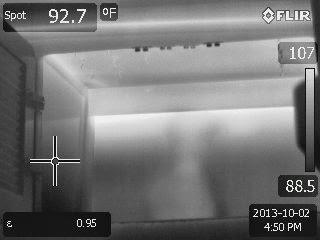
The following images are from the interior:

The interior was imaged with the sun warming the hull. Where the sun did not warm the hull I added heat to the surface. You can make out the chainplate behind the liner in the locker.
dbyachtsurvey.com

In the next image we can change the palette to make the trapped moisture more noticeable.
The purple "blob" being the moisture.

This what we can see with our eyes:

No signs of water intrusion.
The above photo is after the liner was removed and the fiberglass was cut away. You can make out signs of water intrusion, but the chainplate does not look too bad. No cracks and very little corrosion was sighted. It is in my experience though that most signs of corrosion are where you can not see.

Below is a closeup of one of the chainplates. This one does not look too bad either.
dbyachtsurvey,com

Here is what one looks like after it is pulled out of the boat. On the side against the hull there was not much corrosion sighted, but I was able to find cracks. One way I could have found the cracks would to have used dye penetrant to highlight the cracks.

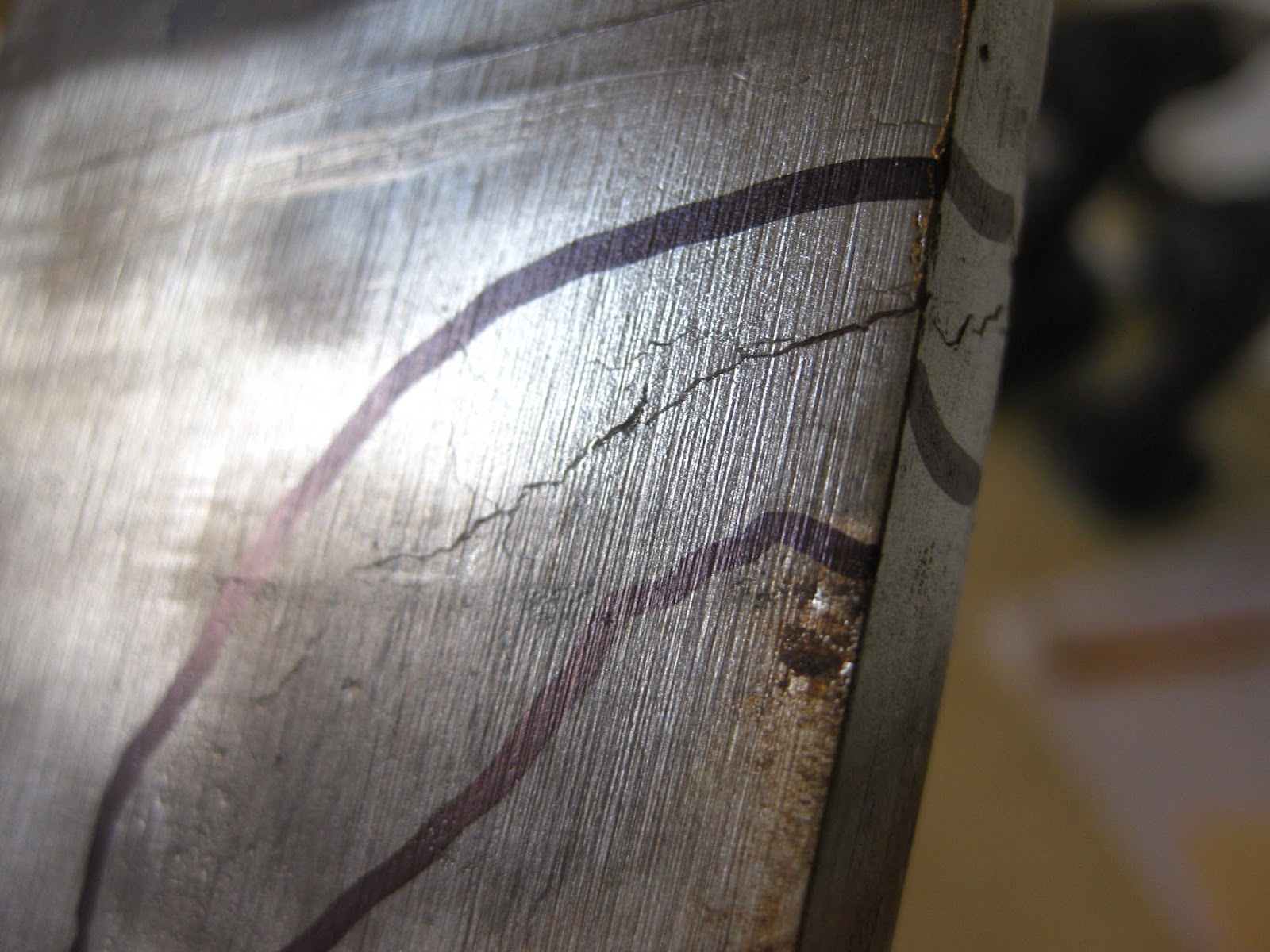


We cut one of the chainplates in half, I was surprised to see the amount of metal wastage.


One of the new chainplates being installed.


dbyachtsurvey.com


Encased Chainplate Alert

The following is the alert that was in the January Seaworthy Magazine, that was mentioned in my last post. Thanks to Beth Leonard at Boat US for permission to post it.

Friday, January 31, 2014

The need of keeping water out of the bilge of a steel boat

I always start my surveys on metal boats by using Thermal Imaging of the hull. This helps me locate the structural components of the metal boat. I am also looking for trapped moisture and/or water. If this is found, then there is a good chance there will be corrosion. Next I conduct an inspection of the bilge of the boat, including, anchor, sail, cockpit lockers, and lazarettes. Now I have a very good idea where to concentrate my UTM-audio gauge. I take readings of the whole hull, but will do more readings in the areas of concern.

When I see water in a bilge of a metal boat beyond what might be in a sump I get concerned. I would like to see dry bilges on all metal boats, but this is not always possible. On Tuesday I surveyed a steel trawler. Overall this boat looked to be in fair condition, but then I saw the water in the bilge, a lot of it! There was heavy scale in some areas because of the standing water.  I knew this was an area I needed to spend some time getting thickness readings.

The next day I did my audio gauge. My readings indicated plate wastage. In some areas I could not get a reading that most likely is caused by heavy scale. My visual inspection from inside confirmed the heavy scale. When I arrived at the boat I noticed some weeping from what I hoped was paint blisters. Then an hour later water stared streaming from one of the blisters. Just to think only the paint was holding this section of plate together.

The good news! The boat was out of the water it will not sink. Steel boats can fixed; by cropping out the bad plate and adding new. In a short period of time, she will be underway again.

The moral of this story? If you own a metal boat keep an eye on the bilges.

I will post some photos next.

Tuesday, January 7, 2014

Brrrrrrr!! It is cold!

In the south we do not winterize our boats, so with this artic blast giving a lot of us below freezing temps for over 24 hours, it would be a good idea for all of us to check on our boats and make sure we do not have any freeze damage. Check all hoses, water and waste tanks, bilges, and thru-hull valves.

Stay warm everyone.

Saturday, December 28, 2013

Happy New Year!

Happy New Year Fellow Boaters!

Some of us have put our boats away for winter while some in the south and in the islands enjoy boating year around. Whether you are using your boat or have winterized it, it is a good time to come up with a to do list for your boat for the upcoming season. Some examples of things to add to your list:
  • Is your safety gear up to date and does it meet federal and your state requirements? Here is a link for the USCG requirements: http://www.uscgboating.org/assets/1/workflow_staging/Publications/420.PDF
  • All boats with living space should have smoke alarms and carbon monoxide alarms, do you? If so, then this is a good time to change batteries if you have not done so.
  • Do you have an EPIRB? If so is the registration and battery in date?
  • Remove your hand held fire extinguishers and turn upside down and hit the bottom with your hand, can you hear the dry powder settle? If not your fire extinguisher might be compacted and need replacement. If any doubts you can have inspected professionally. When was the last time the fire extinguisher in the engine room last inspected?
  • Check you thru-hull vales, are the handles easy to turn, how do they look, corrosion, when was the last time they were serviced? 
  • Check all of the hoses and hose clamps, replace if needed.
  • Inspect your fuel lines and condition of your fuel system. Does your fuel system meet USCG requirements?
  • If you have lead acid batteries, check the electrolyte, are you batteries secure? Are the wire terminals tight?
  • If you have an inboard engine, how is the condition of your stuffing box, cutlass bearing? Is your engine aligned properly.
  • How is the condition of your lifelines? I often find lifelines that need replacement because of corrosion and cracks in the swage fittings.
  • If you own a sailboat, when was the last time the rigging inspected? 
  • On sailboats chain plates are often neglected. Inspect for water intrusion, pitting and cracks. I have found Thermal Imaging to be useful in finding signs of trapped moisture in chain plates embedded in fiberglass.
  • If laying your sailboat up for the season, this is a good time to remove your sails and have them inspected at a sail loft. Also it is a good time to order a new sail, some lofts offer discounts over the winter.
  • Make a list of improvements you want for your boat and get estimates and see if any yards are offering discounts for work completed over the winter.
I am sure I could keep going, but you get the idea. I am wishing everyone a safe and enjoyable 2014!
Happy Boating!

Monday, November 18, 2013

DBYS MARINE SURVEYING

DBYS MARINE SURVEYING 

 Welcome to the blog for Dylan Bailey's Yacht Surveying. In this blog I will document some of my findings and share resources with you.